– Lamiya Siraj
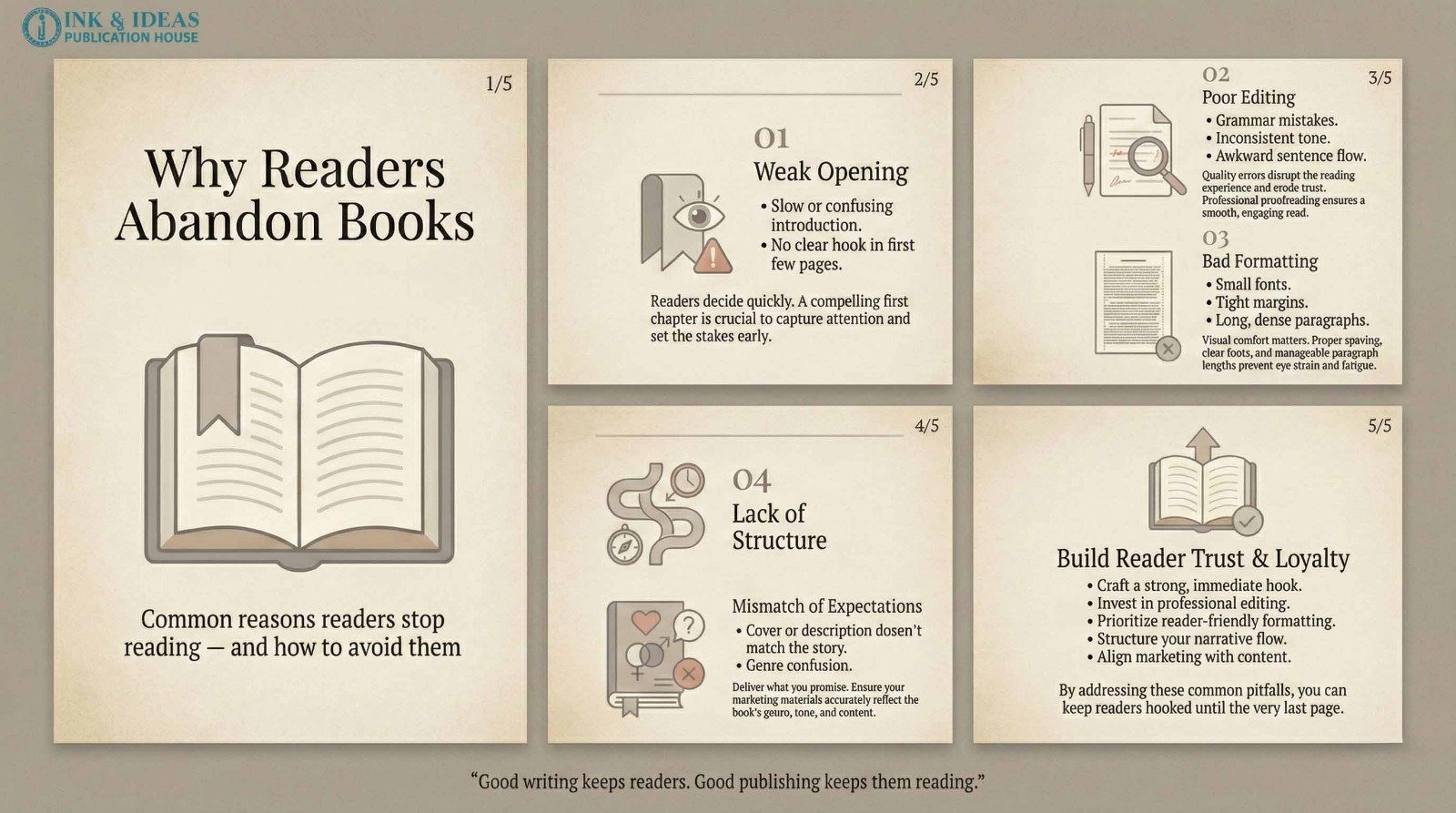
Readers pick up a book with genuine interest. They want to enjoy it, connect with it, and finish it. When they don’t, it’s rarely because they’re impatient or careless. Most of the time, something in the book quietly pushes them away—like a slow leak deflating their enthusiasm page by page. Below are five common reasons readers abandon books, explained in detail, and how authors can fix them.
1. Weak Opening
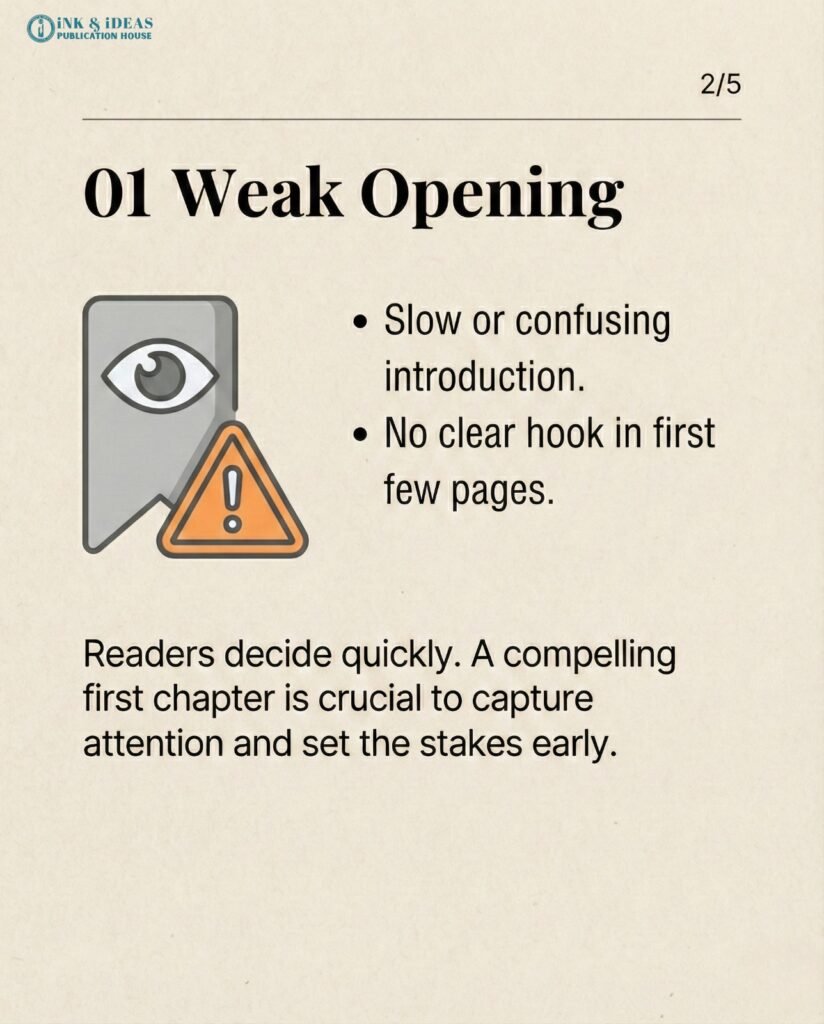
The opening of a book decides its fate. Readers form an opinion within the first few pages, sometimes even the first few paragraphs. If the beginning feels slow, confusing, or overloaded with background information, readers struggle to stay engaged.
What this actually looks like: Imagine opening a mystery novel and spending three pages learning about the protagonist’s childhood pet, their college major, and their apartment’s floor plan—before anything remotely mysterious happens. Or starting a business book that opens with the author’s entire career history instead of addressing the problem you picked up the book to solve.
A weak opening often lacks a clear hook. There is no question, tension, or emotional pull to keep the reader curious. The danger isn’t just boredom—it’s confusion about why they should care. When readers don’t understand why the story or content matters early on, they stop reading.
The fix: A strong opening doesn’t need dramatic action or shocking revelations. It needs clarity and purpose. Consider the difference between these two approaches:
Weak: “Sarah had always been the kind of person who paid attention to details. Growing up in Mumbai, she learned early that small things mattered.”
Strong: “The blood on the kitchen floor was still wet, which meant Sarah had approximately four minutes before her husband came home.”
Notice how the second version immediately raises questions: Whose blood? Why is it there? What happens when the husband arrives? The reader now has a reason to turn the page. For non-fiction, the same principle applies—start with the problem, the surprising fact, or the transformation you’re promising, not the lengthy preamble.
Learn from masters like Chetan Bhagat, who opens Five Point Someone mid-conversation, or Arundhati Roy’s The God of Small Things, which opens with the weight of tragedy making you desperate to understand what happened.
2. Poor Editing
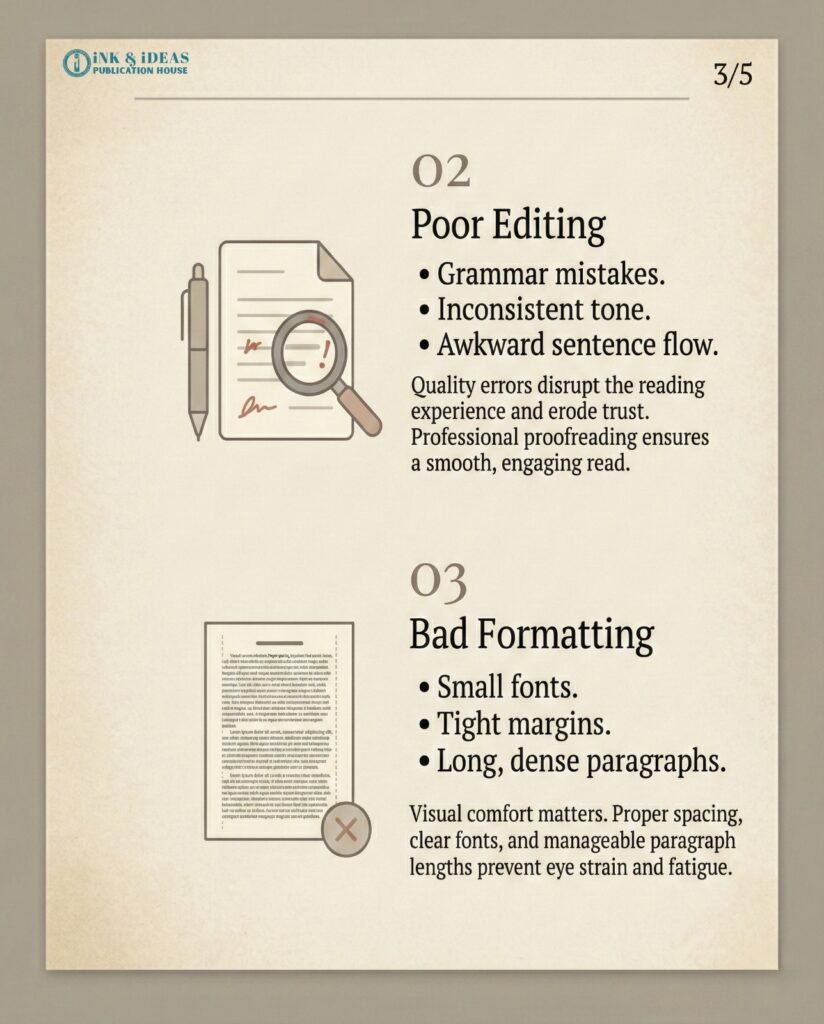
Poor editing breaks the reader’s trust. Grammar mistakes, spelling errors, awkward sentences, and inconsistent tone distract readers from the content. Instead of focusing on the story or message, they start noticing what feels “off.”
Here’s what happens in the reader’s mind: They’re enjoying a tense scene, fully immersed, when suddenly they hit a sentence like “He lead her too the abandoned house where the clues laid waiting.” The misspellings jolt them out of the story. Now they’re thinking about grammar instead of the plot. Do it enough times, and reading becomes work.
Even a powerful idea can lose its impact if it isn’t edited properly. Readers may not consciously analyze the mistakes, but they feel the disruption. Reading starts to feel like an effort rather than enjoyment. It’s like watching a movie where the audio is slightly out of sync—you might not pinpoint the problem right away, but something feels off enough to ruin the experience.
What to do: Even celebrated authors like Ruskin Bond and Anita Desai work with editors. Vikram Seth’s A Suitable Boy went through extensive editing. If the budget is tight, start with a proofreader or use tools like ProWritingAid, then get human eyes on it.
What professional editing provides: Professional editing creates a smooth flow. When done well, it’s invisible—like a well-paved road you drive on without thinking about the asphalt. It catches not just typos, but also:
- Repetitive word choices that dull the prose
- Sentences that require three readings to understand
- Tonal inconsistencies (formal in one chapter, casual in the next)
- Plot holes or logical gaps in non-fiction arguments
This allows readers to stay immersed without interruptions, which is essential for keeping them engaged until the end.
3. Bad Formatting
Formatting affects how a book feels to read. Small fonts, tight margins, long paragraphs, and crowded pages make reading uncomfortable. When the eyes feel strained, readers naturally want to stop.
The physical reality: Picture a page with text crammed edge to edge, no white space, paragraphs running fifteen lines long. Your eyes have nowhere to rest. You lose your place when moving from line to line. What should be a relaxing reading experience becomes a chore, like trying to read a legal contract printed in 8-point font.
In today’s fast-paced world, readers are used to clean, easy-to-read layouts—from their phones, tablets, websites, and well-designed magazines. If a book looks overwhelming on the page, even good content may not be enough to keep them going. First impressions matter, and if a reader opens to a wall of text, they might close the book before reading a single word.
Reader-friendly formatting includes:
- Proper spacing between lines and paragraphs (breathing room for the eyes)
- Readable fonts that aren’t too ornate or difficult to distinguish
- Manageable paragraph lengths (generally 3-5 sentences for fiction, occasionally longer for non-fiction when building complex arguments)
- Strategic use of chapter breaks, section breaks, and white space
- For non-fiction: subheadings, bullet points where appropriate, and visual hierarchy
The fix: Compare your formatting to professionally published books. Pick up a Penguin India edition—notice the spacing, font size, paragraph breaks. Download your book to different devices and actually read a chapter. Does it feel comfortable?
Think of formatting as the architecture of reading: good architecture is noticed only when it’s bad. When a book looks inviting—when the reader’s eye can easily scan the page and find natural resting points—readers are more likely to continue reading for longer periods.
4. Lack of Structure
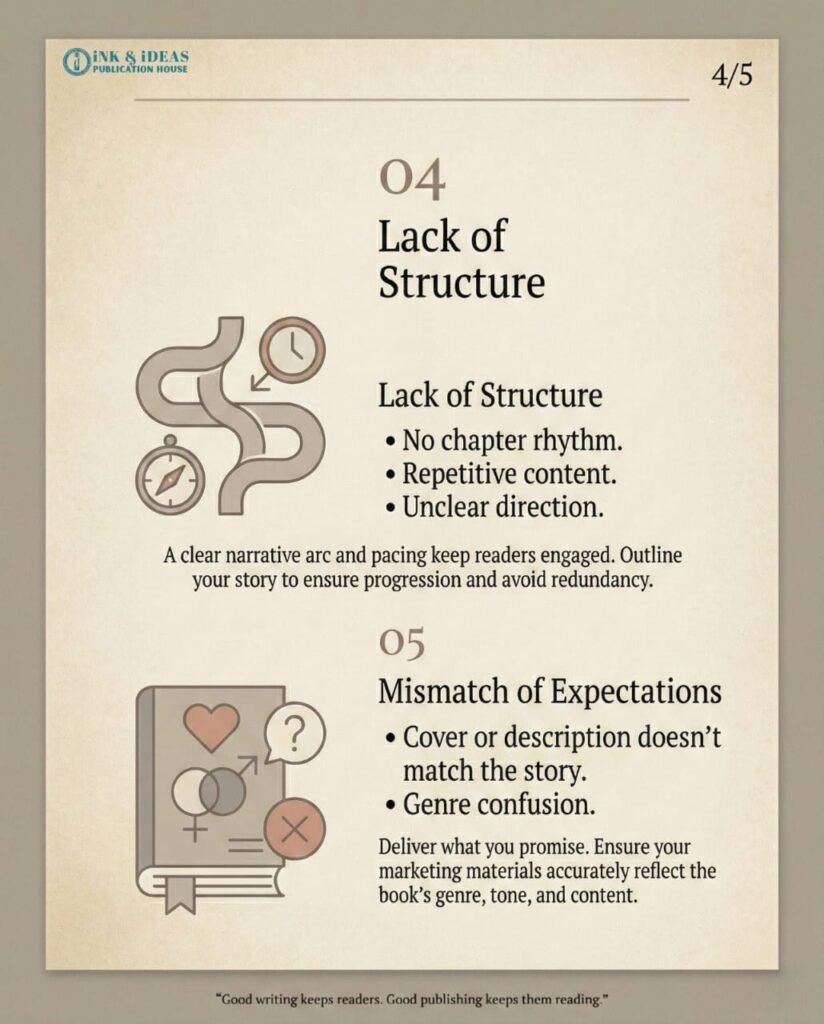
A book without structure feels confusing and tiring. Readers need a sense of direction. When chapters feel repetitive, ideas are scattered, or the pacing is uneven, readers lose interest.
What this looks like in practice: Imagine a thriller where the protagonist has the same argument with their partner in chapters 2, 5, and 9, with no progression. Or a self-help book where chapter 3 discusses advanced techniques while chapter 7 suddenly backtracks to basic concepts. Readers feel like they’re walking in circles rather than moving forward.
Structure helps guide the reader through the journey. It creates rhythm and progress. Each chapter should feel purposeful and move the book forward, whether it’s fiction or non-fiction. In fiction, this might mean escalating conflict, deepening character relationships, or revealing new information. In non-fiction, it means building on previous concepts, creating logical progressions, and delivering on promises made in earlier chapters.
The difference structure makes:
- Without structure: A memoir that jumps randomly between decades with no thematic thread, leaving readers disoriented
- With structure: The same memoir is organized around pivotal moments that connect past and present, showing growth and transformation
When readers can sense clarity and flow—when they feel the book has a destination and is actually heading there—they feel confident continuing. Without structure, even strong content can feel disorganized and hard to follow, like trying to assemble furniture without instructions.
The difference structure makes: Study the pacing in Amish Tripathi’s The Immortals of Meluha—notice how each chapter ends with a hook. Or look at Devdutt Pattanaik’s mythology books—see how he structures complex information into digestible, progressive chapters.
Each chapter should move the book forward. When readers sense you have a destination and are actually heading there, they keep reading.
5. Mismatch of Expectations
Readers approach a book with expectations formed by the cover, title, description, and marketing. When the actual content fails to meet those expectations, disappointment can quickly follow.
Real examples of expectation mismatch:
- A book marketed as a “heartwarming romantic comedy” that’s actually a tragic love story with one funny scene
- A business book titled “The Quick Path to Success” that requires readers to spend five years implementing complex strategies
- A thriller with a dark, ominous cover that turns out to be a cozy mystery with no violence
- A book described as “fast-paced” that spends 200 pages on internal monologue
This often happens when the genre is unclear or when the blurb promises something the book doesn’t deliver. Readers feel misled, even if the writing itself is good. It’s not that the book is bad—it’s that they showed up for pasta and got sushi instead. Both can be delicious, but the disappointment of unmet expectations overshadows the quality.
Why this matters more than ever: In an age where readers have endless options and limited time, they make quick decisions. If your book’s packaging promises a fast-paced adventure but delivers slow-burn character study, readers won’t appreciate the artistry—they’ll feel tricked and leave a one-star review.
The solution: Honest and accurate representation builds trust. When the book delivers exactly what it promises—when the cover, title, description, and content all align—readers feel satisfied and are more likely to finish it and recommend it to others. Your goal isn’t to trick the maximum number of people into buying; it’s to attract the right readers who will genuinely enjoy what you’ve written.
Look at Durjoy Datta’s books—marketed exactly as the young adult romance they are. Ashwin Sanghi’s thrillers promise historical mysteries with contemporary action, and that’s what readers get. Honest positioning builds trust.
What You Can Do Right Now
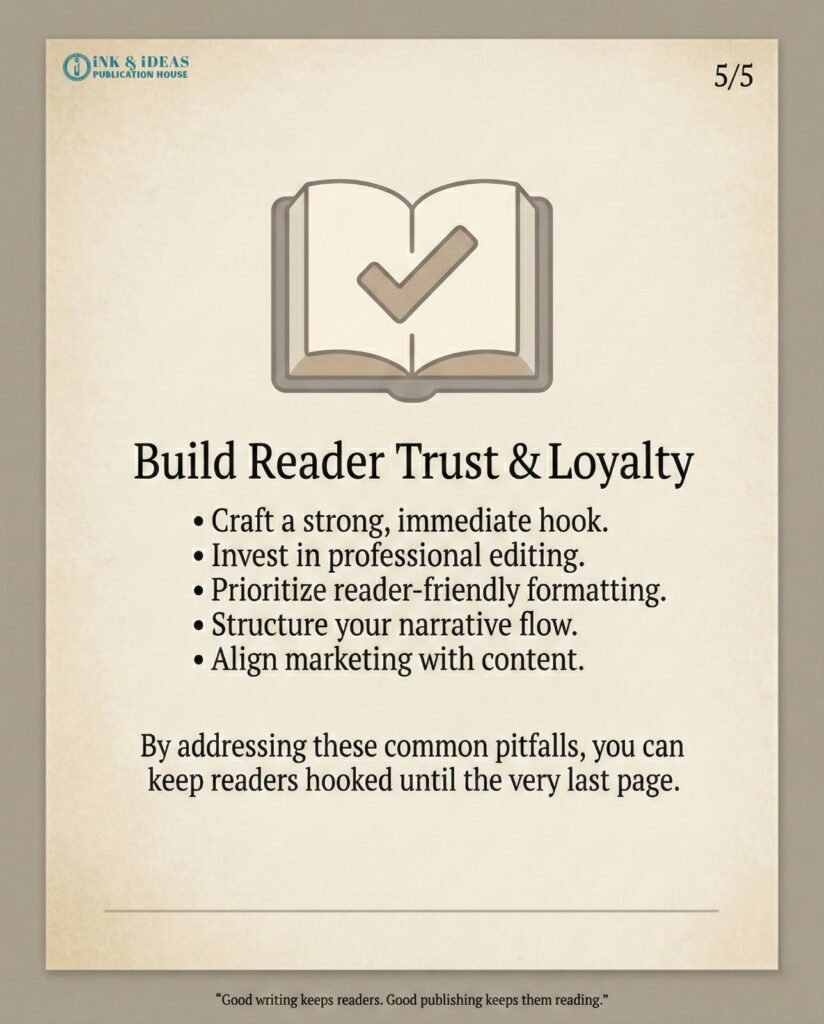
This Week:
- Audit your opening – Read the first three pages as a stranger. Would you keep reading?
- Check formatting – Download your book to a Kindle and phone. Is it comfortable to read?
- Test your marketing – Show your cover and blurb to five target readers. What do they expect? Does it match what you wrote?
This Month:
- Get editing help – Even a sample edit of one chapter shows what needs work
- Map your structure – Write one sentence per chapter describing what it accomplishes. Any repetition?
Before Launch: Review all marketing materials against your actual content. Adjust positioning to match reality.
The Bottom Line
Readers don’t abandon books out of cruelty. They abandon them because life is short and options are endless. But here’s the good news: every point in this article is fixable.
The authors whose books get finished, remembered, and recommended aren’t necessarily the most talented—they’re the ones who respected their readers enough to polish every element until it shone.
Your readers are waiting. Give them a book they can’t put down.
Discover more from Ink And Ideas Publication House
Subscribe to get the latest posts sent to your email.