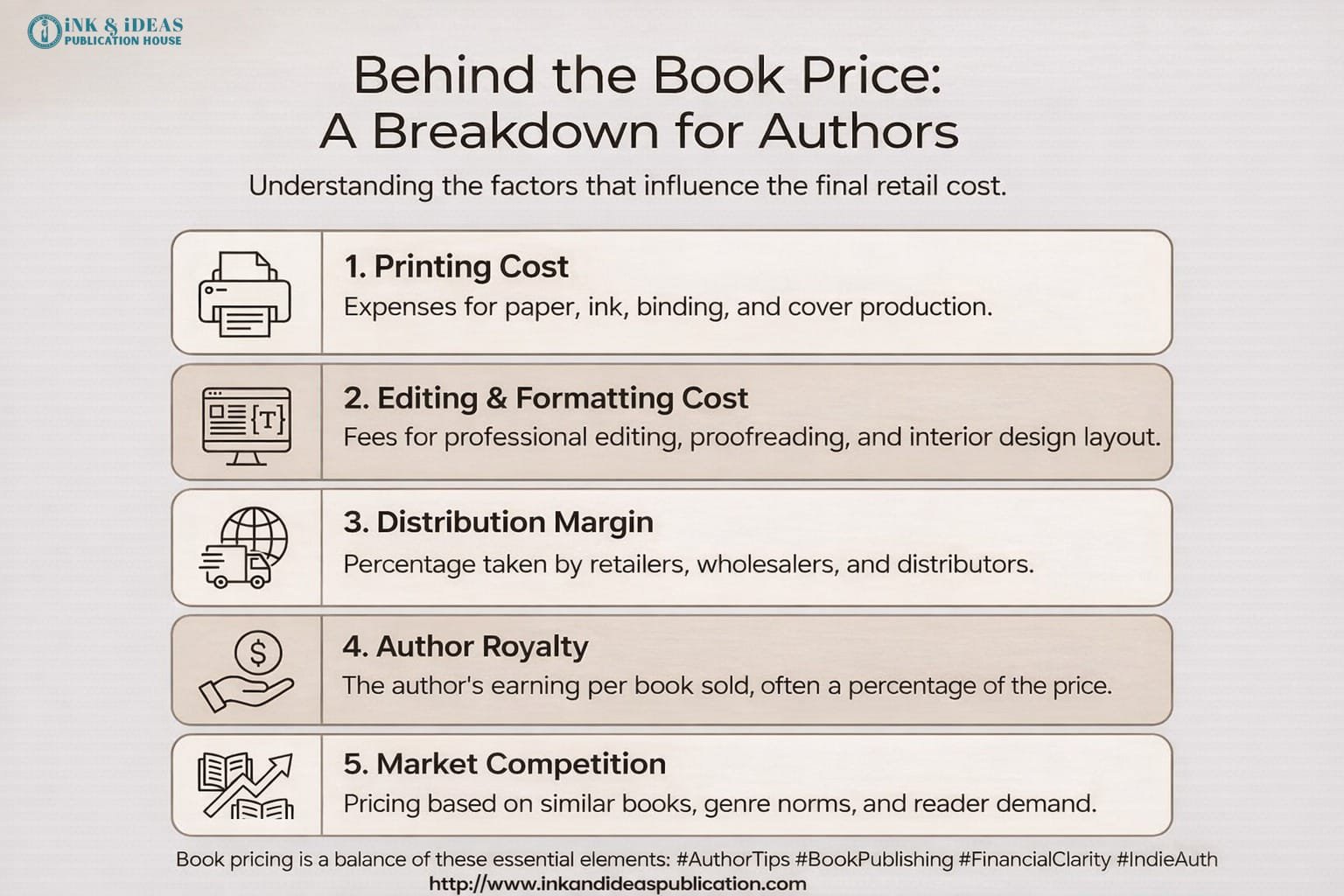
At Ink and Ideas, we believe informed authors make the best partners. One question we hear constantly is about book pricing — so we wanted to pull back the curtain and show you exactly how it works.
“Why is my book priced at ₹399?”
I’ve heard this question more times than I can count. Sometimes it comes with frustration. Sometimes with confusion. And almost always, with a sense that there’s something hidden behind that number.
Here’s the truth: there is.
But it’s not a secret meant to be kept from you. It’s just… complicated. And today, I want to pull back the curtain and walk you through it — not as a lecture, but as a conversation.
Because once you understand what goes into that price tag, everything starts to make sense.
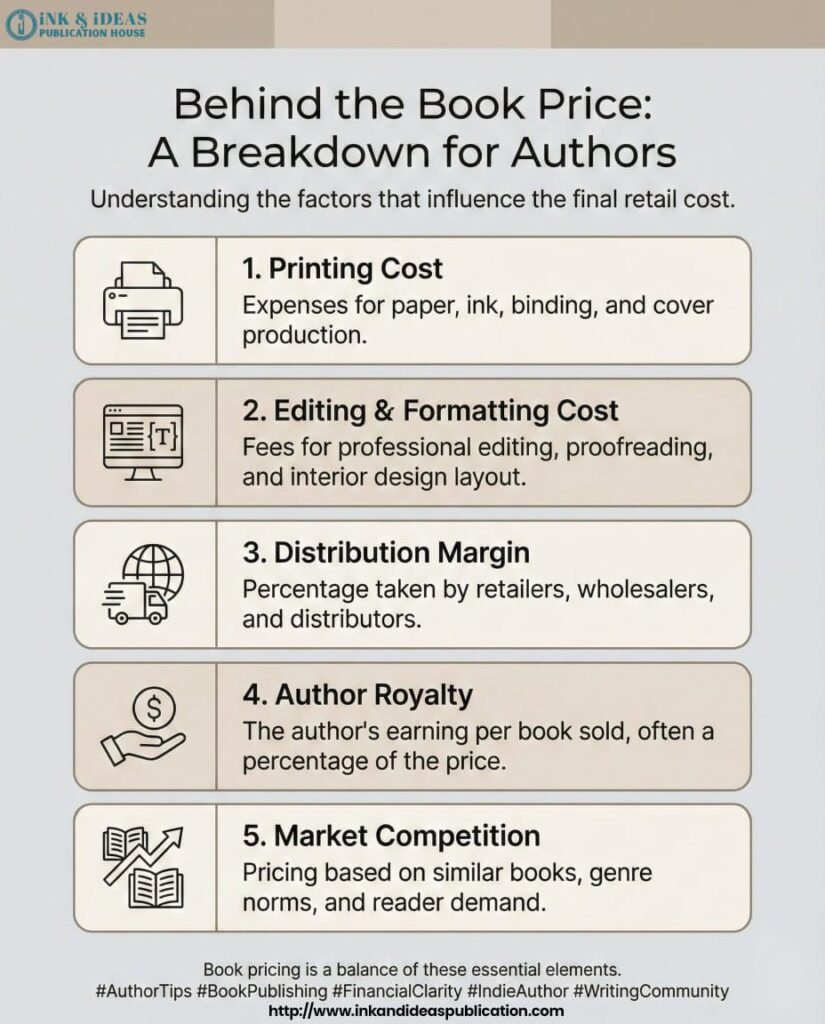
Printing Cost (The Obvious One)
Let’s start with what you can see and touch: the physical book itself.
Paper quality. Page count. Hardcover or paperback. Matte or glossy finish. Every single choice adds up.
Print 50 copies of a 300-page book? Expensive per unit. Print 1,000? Much cheaper per copy. That’s just how printing works — economies of scale.
And here’s the thing: readers feel quality. They notice the weight of the paper, the crispness of the text, and the smoothness of the cover. So while printing is the foundation, it’s also your first impression.
Editing and Formatting (The Invisible Work)
This is where a lot of authors underestimate the cost — because they don’t see it.
A professionally published book doesn’t just get “spell-checked.” It gets refined. Restructured. Polished until it flows. Line edits. Developmental edits. Proofreading. Interior design. Typesetting.
Think of it like this: you wrote the book. But editing is what makes it feel like a book.
It’s the difference between a homemade meal and a plated dish at a restaurant. Same ingredients. Different execution.
This work takes time, skill, and money. And yes, it absolutely affects pricing.
Distribution Margin (The Part Nobody Warns You About)
Here’s where it gets tricky.
When your book lands on a bookstore shelf or an online platform, you’re not the only one getting paid. The retailer takes a cut. The distributor takes a cut. Sometimes the platform also takes a cut.
In some cases, this can be 40–50% of the retail price.
So if your book is priced at ₹500, don’t assume that’s what you or your publisher is pocketing. A chunk of it is already spoken for before a single sale is made.
That’s why pricing has to account for everyone in the chain — or the math just doesn’t work.
Author Royalty (Your Slice of the Pie)
Your royalty is usually a percentage of the book’s price — or sometimes, the net revenue after costs.
But here’s the catch: it only makes sense if the price itself makes sense.
Underprice your book to look “affordable,” and your royalty shrinks to almost nothing. Overprice it without market logic, and sales drop.
The sweet spot? It’s where your book is valued fairly, and you’re compensated fairly.
That balance isn’t easy. But it’s essential.
Market Competition (What the Reader Expects)
Finally, let’s talk about context.
A poetry chapbook and a 400-page business guide won’t — and shouldn’t — be priced the same. A debut author’s first novel will likely be positioned differently than a bestselling author’s tenth book.
Readers have expectations. They compare. They judge value based on what else is out there.
So pricing isn’t just about your costs. It’s also about where your book fits in the world.
The Bottom Line
Book pricing isn’t random. It’s not arbitrary. It’s not designed to shortchange you.
It’s a careful, sometimes frustrating, always strategic balance between:
- What it costs to make
- What’s it worth reading to readers
- What the market will bear
- What keeps everyone in the chain sustainable
Once you understand that, pricing stops feeling like a mystery. It starts feeling like a tool.
And when you see it that way? You’re not just an author anymore.
You’re a professional who understands the business of books.
And that shift? That’s everything.
Discover more from Ink And Ideas Publication House
Subscribe to get the latest posts sent to your email.