
A no-fluff, realistic breakdown of where the income really comes from — and how to build it deliberately.
Most people who dream of writing a book picture the same thing: publishing it, watching it sell, and depositing royalties. It’s a seductive vision — and almost entirely wrong. The authors who build lasting income don’t rely on a single channel. They build an ecosystem where the book is the starting point, not the finish line.
Publishing has always been a slow, layered business — but in 2026, the variety of income paths available to an author has never been greater. The challenge is knowing which ones to pursue, and in what order. This guide breaks it down honestly, without the hype.
Book Royalties — The Foundation, Not the Ceiling
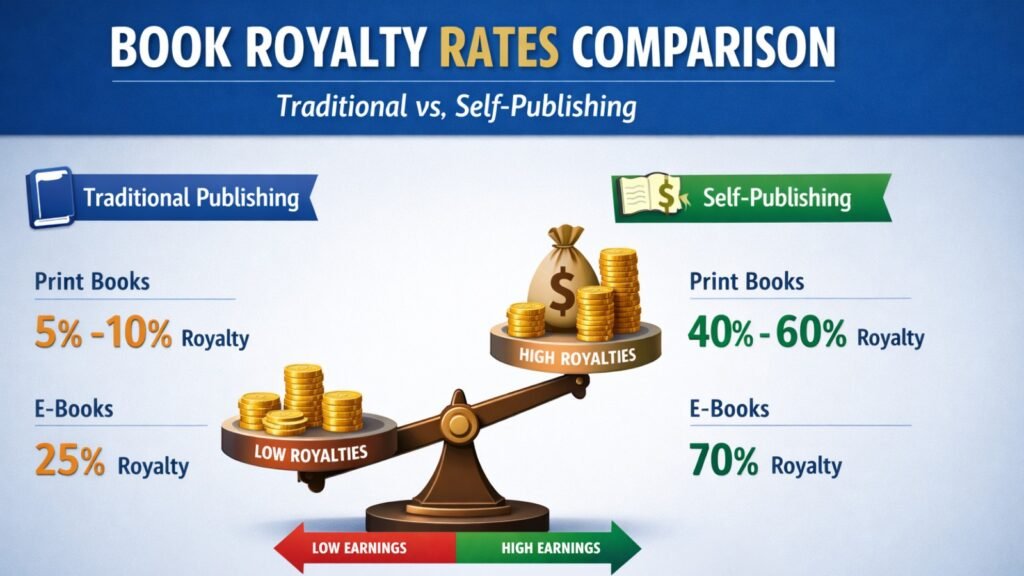
Royalties are what most people think of when they imagine author income. They’re real, but they’re rarely enough on their own — at least not from a single title.
Traditional Publishing
With a traditional publisher, you typically receive an advance against future royalties — a lump sum paid upfront. Once your book “earns out” that advance through sales, you start seeing royalty cheques. The rates look like this:
| Format | Typical Royalty Rate |
|---|---|
| Hardcover | 7–10% of cover price |
| Paperback | 5–8% of cover price |
| Ebook | 20–25% of publisher’s net receipts |
The advance can range from a few thousand dollars for a debut novel to seven figures for a high-profile deal — but most debut authors are in the modest range, and many never earn beyond their advance.
Self-Publishing
Self-publishing flips the equation: you keep far more of each sale, but you fund everything upfront — editing, design, marketing. The margins are genuinely attractive:
| Format | Royalty Range |
|---|---|
| Ebook (e.g. Kindle Direct) | 35–70% depending on price point |
| Print-on-demand paperback | 30–60% after print costs |
The caveat: a high royalty rate on a book that sells 50 copies a month is still modest income. Scale matters. Most self-published authors begin to see meaningful royalties when they have three or more titles building on each other.
The real truth about royalties: Income from book sales grows proportionally with the size of your backlist. One book is a trickle. Five interconnected books — especially in a series or a focused niche — can become a genuine income stream. This is why serious authors treat every title as an investment in the next one.
Speaking Engagements — Where Authority Converts to Cash

A published book does something a portfolio or LinkedIn profile cannot: it positions you as the definitive expert on your subject. That positioning opens doors to paid speaking opportunities that can quickly outpace what the book earns on its own.
The range is broad. Nonfiction authors — especially those covering business, health, leadership, or personal development — are frequently booked for corporate talks, conferences, and industry events, often at fees starting from a few hundred dollars and scaling into the tens of thousands for established names. Fiction authors aren’t excluded: literary festivals, school visits, creative writing workshops, and storytelling masterclasses are all viable and growing markets.
The key is thinking of your book not as a product but as your professional calling card. Every engagement you do sells more books. Every book sold builds the case for your next engagement.
Courses & Digital Products — Often the Biggest Earner

Here’s what surprises most aspiring authors: for many successful publishing professionals, courses and digital products generate more revenue than book royalties ever have.
The logic is simple. A book priced at ₹500 earns you perhaps ₹50-₹180 per copy after costs. A course priced at ₹1,0000 earns you ₹8000 or more — and can be sold repeatedly to the same audience your book builds. Formats that work well include recorded video courses, live cohort-based workshops, downloadable workbooks and templates, and private membership communities.
Think of the book as the proof of expertise, and the course as the delivery of that expertise in depth. The ecosystem works because readers who love your book are the warmest possible audience for your paid products. They already trust your thinking — they want more of it.
Freelance Services — Steady Income While the Long Game Plays Out
Publishing a book changes how the market perceives you. What was once a portfolio of work becomes a credential. And credentials attract clients.
Authors regularly leverage their published status into freelance income through ghostwriting, editing and developmental consulting, content strategy, scriptwriting for video and podcasts, and business writing or copywriting. The rates for these services are substantially higher for an author with a published title than for someone without one — the same skills command more because trust has been publicly established.
For many authors, particularly in the early years, services provide the reliable monthly income that allows them to keep writing without financial pressure. The book builds the reputation; the services fund the next book. It’s a cycle that many editorial businesses are built on.

Foreign Rights & Licensing — Passive Income From Intellectual Property
Your book is not just a book. It is a piece of intellectual property — and intellectual property can be licensed, translated, adapted, and monetised in ways that have nothing to do with the original sale.
Foreign rights deals allow publishers in other countries to release translated editions of your work. Audiobook rights can be sold or self-produced (audiobooks now represent one of the fastest-growing segments in publishing). Film and TV adaptation rights, while competitive, represent potentially life-changing sums. Even modest books have generated meaningful licensing income from unexpected directions. The key is understanding that once created, your book can keep working for you across multiple markets and formats simultaneously — without additional writing effort.

Direct Reader Relationships — Memberships, Newsletters & Patreon
The most durable form of author income in 2026 is the direct relationship with readers. Platforms and algorithms change; your email list and your community belong to you.
Paid newsletters (via Substack, Beehiiv, or a private mailing list) allow readers to subscribe for exclusive content, early access, or behind-the-scenes insights. Patreon tiers give readers a way to support authors they love at different contribution levels in exchange for exclusive chapters, Q&As, or merchandise. Private communities — hosted on Discord, Circle, or similar platforms — create spaces where readers engage with each other and with the author directly.
What readers are buying in these arrangements isn’t just information or entertainment. They’re buying proximity and connection. Authors who understand this build remarkably loyal communities that sustain income regardless of where any individual book ranks in the charts.
Paid newsletters and reader communities give authors an income stream that no algorithm can take away — your email list belongs to you.
Affiliate Income & Brand Partnerships — Leveraging Your Platform
As an author’s audience grows, so does the value they bring to brands. Affiliate programmes — recommending writing tools, software, books, or services and earning a commission on sales — require almost no additional effort once set up. Brand partnerships and sponsored content are the next tier: companies pay to be associated with your platform because your audience trusts your recommendations.
This income stream rewards audience size and trust above all else. It tends to arrive later in an author’s career, once a meaningful platform has been established. But for authors who invest in building a media presence early — through a website, newsletter, podcast, or social media — it can become a significant additional layer of income.
The Truth Most Publishing Advice Skips Over
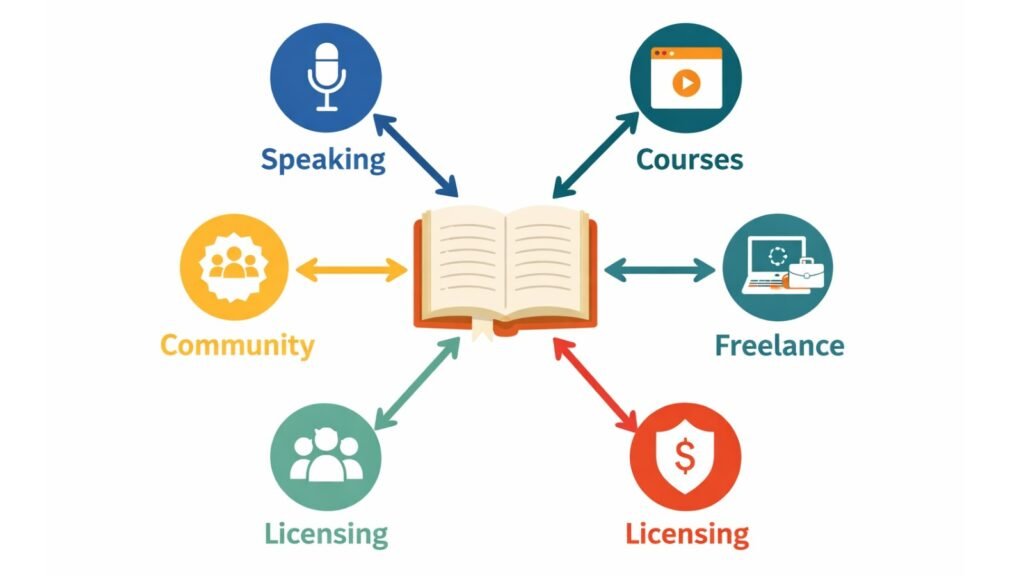
Authors who make a sustainable income from writing don’t wait for royalties to save them. They understand that a book creates four things that are worth more than the cover price:
The book is the gateway. What you build through that gateway is where the career actually lives.
How Long Does It Actually Take?
Timelines vary, but a realistic pattern looks like this:
Book One — Investment Phase
Most authors lose money or break even. Costs of editing, design, and marketing typically exceed returns. This is normal and expected — you’re building the foundation.
Book Two — Break-Even Phase
Your first book continues to sell while the second launches. You have an audience now. Marketing costs are lower because trust already exists. Services or speaking may have begun generating supplementary income.
Book Three and Beyond — Profit Phase
The backlist compounds. Each new book brings readers back to the earlier titles. The ecosystem — courses, speaking, community — has had time to develop. Income becomes genuinely sustainable.
Publishing is a long game. The authors who succeed financially are not the ones who wrote the best first book — they’re the ones who kept going, kept building, and treated their writing career as a business that required patience and strategy in equal measure.
What Determines Whether a Book Makes Money
✔️ Professional editing: Unedited books accumulate poor reviews, which kills discoverability and word-of-mouth — the two primary drivers of long-term book sales.
✔️ Strategic positioning: Books that solve a specific problem or evoke a clear emotional response outsell those that try to appeal to everyone.
✔️ Consistent marketing: No audience-building means no sales. Marketing is not optional; it’s part of the job.
✔️ A growing backlist: More titles compound the income. Each book amplifies the others.
✔️ Email list ownership: An author’s most valuable asset is not their social following — it’s the direct line to readers they own outright.
✔️ Multiple income channels: Relying on royalties alone is the most fragile publishing strategy. Diversification is survival.
Your Book Is the Beginning, Not the Destination
The authors who succeed financially think of publishing as a business built on intellectual property — not a one-time product launch. If you want your book to earn, to open doors, and to build something lasting, it starts with writing and publishing it properly. That means professional editing, strategic positioning, and a plan that extends well beyond the release date.
Article · Writing Business · Publishing Strategy · 2026 Edition
Discover more from Ink And Ideas Publication House
Subscribe to get the latest posts sent to your email.